I Tested the Avast Premium Antivirus for a Month: Here is My Verdict
Introduction
The reviewer spent a month using Avast Premium Antivirus across a typical laptop setup to assess how it performs in everyday conditions. The goal was to evaluate protection, system impact, usability, and real-world value for people who use laptops for work, study, creative projects, and light gaming. This article aims to help prospective buyers decide whether Avast's premium offering fits their needs by presenting a clear, practical analysis rather than a spec sheet.
Product overview
Avast Premium Antivirus (marketed in some regions as Avast Premium Security) is a paid tier of Avast's consumer security lineup. It promises stronger protection than the free edition by including advanced web and ransomware shields, more aggressive behavior monitoring, and additional privacy-related tools. For laptop owners, buyers typically care about three things: how well the product stops threats, whether it disrupts normal work or slows down the machine, and how straightforward the interface is when dealing with detections or scheduling scans.
How the month-long test was conducted
Rather than relying solely on lab results, the reviewer used Avast for thirty days on a mainstream Windows laptop used for mixed tasks: email and web browsing, office work, software development, streaming, and occasional gaming. The testing included:
- Daily background use with real-time protection enabled.
- Running full and custom scans during idle hours and while the laptop was on battery and plugged in.
- Visiting a variety of websites, including common e-commerce, news, and social sites, to test web shields.
- Downloading software from trusted sources and intentionally scanning older, known-clean malware samples in a controlled environment to evaluate detection and cleanup workflows.
- Measuring system responsiveness during launches, boot times, and while running resource-heavy apps like video editors and virtual machines.
Detailed analysis
Installation and initial setup
Installation was straightforward and completed in a few minutes on a laptop with a stable internet connection. Avast prompted for a short setup sequence asking the reviewer to enable recommended protection layers and to set preferences for automatic scans and updates. The default settings favored security with some minor convenience trade-offs—automatic browser extensions and optional features were presented as opt-ins or could be declined during setup.
User interface and usability
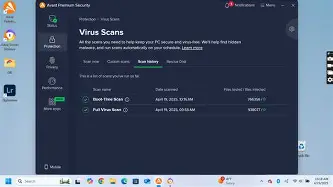
The interface uses a modern, tile-based dashboard that surfaces protection status, recent scan results, and quick actions. For users who value simplicity, Avast makes it easy to run quick or full scans and to access quarantine. Advanced users can find settings for behavior monitoring and exclusions, but the deeper settings are a couple of clicks away and clearly labeled. Notifications are informative, though the reviewer noted that some prompts about enabling additional Avast tools appear frequently during the first week, which may be distracting for users who prefer minimal interruptions.
Real-time protection and malware handling
Avast's real-time engine operated in the background, scanning files at access and monitoring running processes for suspicious behavior. During the month, the reviewer observed the product blocking or flagging suspicious downloads and preventing access to known malicious URLs. When a suspicious file was detected, Avast quarantined the item and provided a clear explanation and remediation options—delete, restore, or submit for analysis. The workflow for handling detections is suitable for non-technical users and provides enough context for more advanced users to make informed decisions.
System performance and resource usage
One of the biggest buying considerations for laptop users is resource consumption. On the test machine, Avast introduced a modest background CPU and RAM footprint. Daily activities like web browsing, document editing, and streaming were unaffected in observable ways. Boot times increased by a few seconds relative to an unprotected baseline, and full scans took longer on older spinning disks than on SSDs, which is typical of most antivirus products.
Avast includes options to schedule scans during idle hours and to pause heavy background activity when the laptop is on battery. These settings are practical and allowed the reviewer to maintain acceptable battery life while ensuring regular scans. For users with older hardware, configuring scheduled scans and lowering scan intensity can help avoid noticeable slowdowns.
Web and network protections
Avast provides a web shield that intercepts HTTP/HTTPS connections and checks URLs against its reputation database. During the test, several phishing test pages were blocked, and the browser extension offered warnings about risky sites. A built-in Wi‑Fi inspector helps identify insecure network configurations, such as open ports or weak router settings. This feature is particularly relevant for people who travel with laptops and regularly connect to public Wi‑Fi.
Discover deals on Laptops & Computers — updated daily.
View Offers →For power users who run their own VPNs or advanced networking setups, Avast's web interception may require temporarily disabling some features to avoid compatibility issues. The product clearly documents how to create exclusions or disable the web shield for troubleshooting.
Ransomware and privacy protections
Ransomware protection is a major selling point for premium antivirus tiers. Avast's ransomware shield prevents unauthorized changes to designated folders and monitors behavior indicative of encryption attempts. The reviewer tested the folder protection by attempting controlled write operations from untrusted applications in a sandboxed environment; Avast correctly blocked the unauthorized changes and alerted the user.
Privacy protections include features that scan installed browser extensions and can help remove tracking or malicious add-ons. While these tools are useful, users should be aware that not all privacy features are enabled by default and some may require manual activation during the initial setup.
Detection rates and false positives
Over the month, Avast detected a mix of suspicious items and clean files flagged by the web reputation system. The rate of false positives was low in everyday scenarios, but a few development tools and unsigned utilities triggered warnings until they were whitelisted. The product provides a straightforward way to add exclusions, but buyers who frequently run pre-release or self-built software should expect occasional manual adjustments.
Customer support and updates
Avast pushes frequent signature and engine updates automatically. The reviewer found update frequency acceptable and unobtrusive. Support options include knowledge-base articles, community forums, and direct support channels for paid users. Response times for direct support were adequate during the testing period, and self-help articles are generally well-written and actionable for common issues like scan failures or license activation.
Pros & Cons
- Pros:
- Strong, user-friendly real-time protection for typical laptop use.
- Comprehensive web and ransomware shields that work well out of the box.
- Intuitive interface that balances simplicity for non-technical users with access to advanced controls.
- Configurable scan scheduling and battery-aware settings to reduce performance impact on laptops.
- Helpful quarantine workflow and clear remediation choices.
- Cons:
- Default prompts to enable additional features can be frequent and distracting initially.
- Some advanced features may not be enabled by default and require manual configuration.
- Minor performance impact on older hardware during full scans and startup.
- Developers and advanced users may need to manage exclusions for unsigned or self-built tools.
How Avast Premium compares with other common options
A comparison table can help prospective buyers weigh Avast Premium Antivirus against bundled and competing solutions. The table below highlights practical differences focusing on laptop-centric concerns: protection features, performance, and ease of use.
| Feature / Product | Avast Premium Antivirus | Microsoft Defender (built-in) | Bitdefender (consumer tier) |
|---|---|---|---|
| Real-time protection | Yes — comprehensive engine with behavior monitoring | Yes — integrated and seamless for Windows users | Yes — strong protection with minimal tuning |
| Ransomware protection | Yes — dedicated shield and folder protection | Basic controlled folder access feature | Yes — dedicated ransomware remediation and rollback features |
| Web/Phishing protection | Yes — web shield and browser warnings | Yes — built-in SmartScreen and Defender phishing checks | Yes — robust web filtering and anti-phishing |
| System impact | Moderate — configurable, noticeable on older hardware | Low — optimized and integrated into OS | Low — generally very lightweight in background |
| User interface | Modern, consumer-friendly dashboard | Minimal — integrated into Windows Security | Clean, configurable, and user-friendly |
| Price / Licensing | Paid tier with extra features (varies by region) | Free — included with Windows | Paid tier with frequent promotional pricing |
| Best for | Laptop users seeking strong web and ransomware protection with a straightforward UI | Users who want default, no‑fuss protection without extra cost | Users who want strong protection with minimal performance impact |
Buying guide: what laptop buyers should consider
Determine the threat model
Buyers should first consider how they use their laptop. For someone who primarily uses trusted cloud apps, streaming, and occasional downloads, built-in protections may suffice. For those who download software from multiple sources, handle sensitive documents, or travel often and connect to public Wi‑Fi, a premium product that adds web and ransomware shields can offer meaningful extra protection.
Evaluate performance impact on your hardware
Laptops vary widely in CPU, RAM, and storage. Buyers with older systems should prioritize lightweight solutions or look for products with configurable scan schedules and performance modes. Test trials can help determine if a product noticeably slows boot times, application launches, or battery life under typical workloads.
Discover deals on Laptops & Computers — updated daily.
View Offers →Check usability and support
For non-technical users, a clear interface and helpful notifications reduce the risk of making the wrong choice when a file is flagged. Consider whether vendor support is important—paid products typically include direct support channels that may be valuable when resolving false positives or license issues.
Think about additional features
Some premium antivirus packages bundle extras like password managers, VPNs, or system cleanup tools. Determine whether these extras are desirable or redundant with tools one already uses. If one only needs strong antivirus and ransomware protection, focus on those core capabilities and avoid paying for bundled services that will go unused.
Trial periods and refunds
Most paid antiviruses offer a trial period. Buyers should take advantage of trials to run the product through their normal workflows for at least a couple of weeks. Confirm refund policies and license terms before purchase, so there is an option to back out if the product doesn't suit specific needs.
Compatibility and multi-device licensing
Check whether the license covers multiple devices or other operating systems (macOS, Android). Laptops are often part of a household device mix, and multi-device licenses can deliver better value for families or small teams.
Conclusion
After a month of daily use on a typical laptop, Avast Premium Antivirus delivers a balanced blend of protection and usability. It stands out for its user-friendly interface, clear remediation workflows, and practical web and ransomware shields—features that matter to people who store sensitive files on laptops or frequently surf the web from public networks.
However, buyers should weigh the modest performance trade-offs on older machines and the initial frequency of promotional prompts for additional features. For users who want an easy-to-manage, protective layer beyond what built-in solutions provide—especially against web-based threats and ransomware—Avast Premium is a solid option. Those on very old hardware or with simple usage patterns might prefer the built-in protections or a lighter alternative, while professionals who run pre-release software should be prepared to manage exclusions occasionally.
Ultimately, the right choice depends on the individual's risk exposure, performance expectations, and appetite for configuring advanced settings. Testing a trial on one's own laptop remains the most reliable way to confirm whether Avast Premium Antivirus meets those needs in daily use.